My summary of Developmental Politics by Steve McIntosh:
- Premise: US (and other heterogeneous modern democracies) sense of nationhood is broken into factions that hate each other and have trouble working together.
- Diagnosis: There are 3-4 major worldviews involved who see each other as the enemy, and have different identities and value systems
- Traditionalists
- Modernists (some more conservative, some more liberal)
- Progressivists (it’s got to end with ist, right?)
- Proposal: If we want a harmonious political environment where we can get things done, we have two options:
- Eliminate some of these factions
- Developed a shared goal they can all relate to, and see themselves as a part of
- Constraint: Eliminating millions of people has certain ethical problems, but even beyond those, each of these factions represents something fundamentally True and Valuable (in addition to their pathological bullshit), and we would suffer as a country without their input and perspective. So, we’re kind of forced into developing a shared goal.
- Proposal: The shared goal has to be something each worldview/identity/vocabulary can get behind, therefore allowing the members of the different groups to feel solidarity with each other
- Constraint: Feeling solidarity is a high bar! The shared goal or project has to be touch upon something that really matters, like meaning or purpose. This is religious territory, and thus dangerous because these groups have very different relationships to religious territory.
- Constraint: While many of us don’t like religion, we all have the itch it tries to scratch.
- Proposal: One way of scratching the itch that everyone can get behind (according to Steve) would be to cultivate a system of virtues that are general enough that everyone says “that’s a good idea”, but abstract enough that each person/group can interpret it the way they want. This leaves space for solidarity and contentious dialogue (which is a good thing).
So he starts with “man, we’re hosed” (I agree!) and then diagnoses the problem as competing worldviews. All categorization systems are inherently flawed, so let’s just accept his categories as imperfect and move on…
I read Ken Wilber, I’m sympathetic to the worldviews thing (aka developmental stages or spaceship levels).
Here’s his summary graphic of the worldviews he’s talking about. Sometimes he splits modernist into two camps (liberal and conservative), so there are 4 instead of 3.
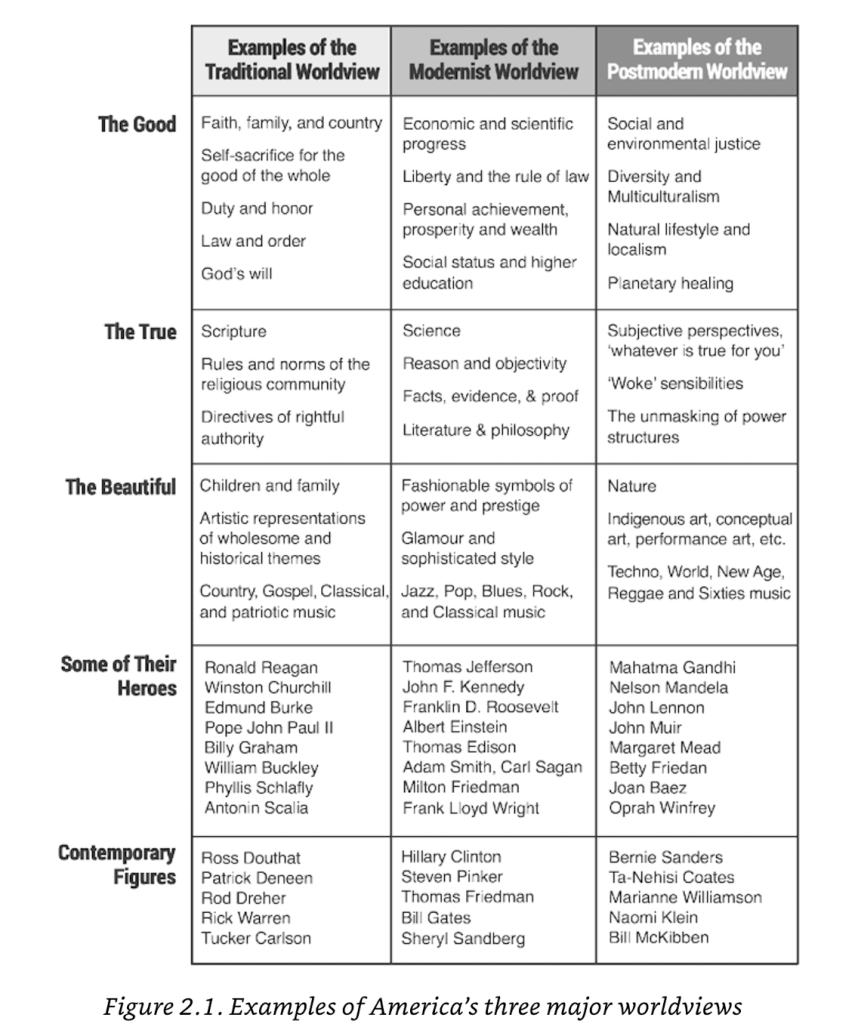
He then talks about some of the benefits and drawbacks of each of the worldviews, and makes the case they were all necessary reactions to what came before them, and are still necessary to our proper functioning. I like that.
Here’s his summary graphic of some of the benefits and drawbacks of each worldview.
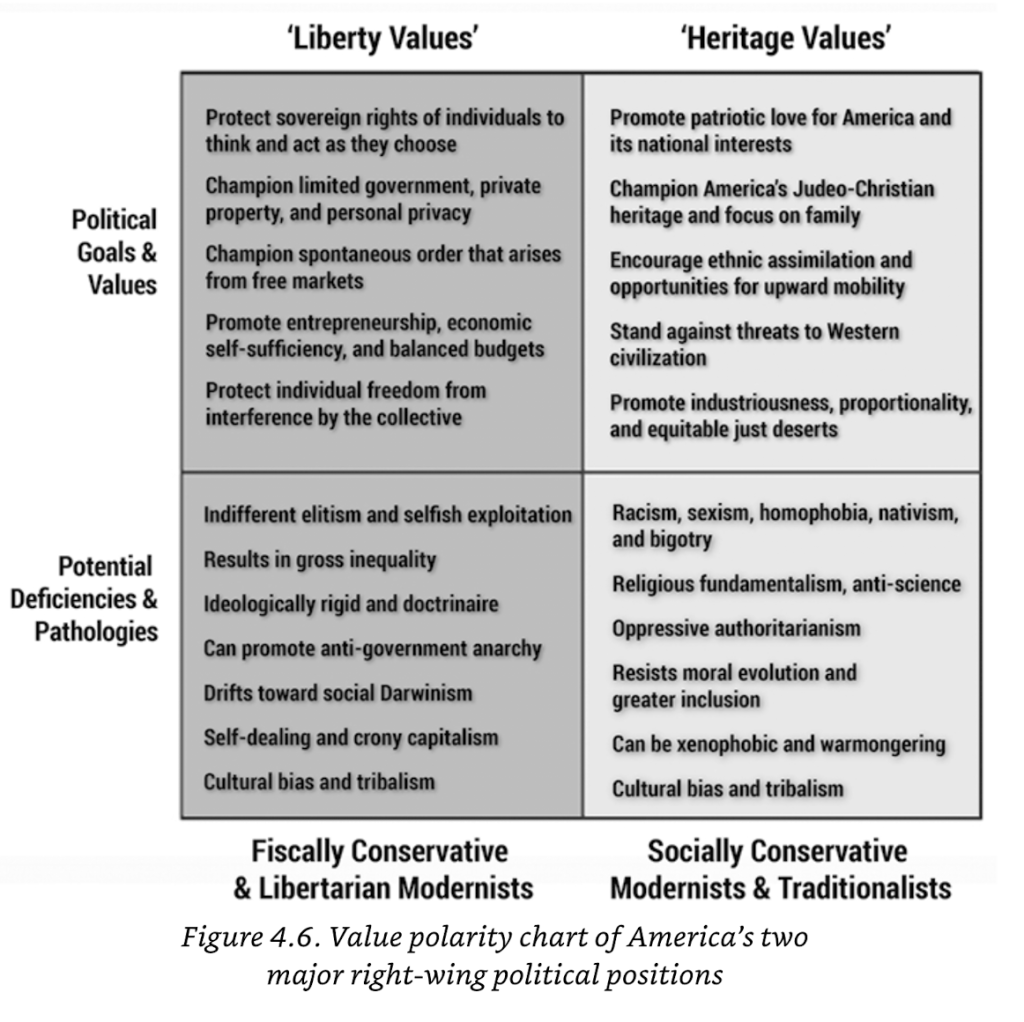
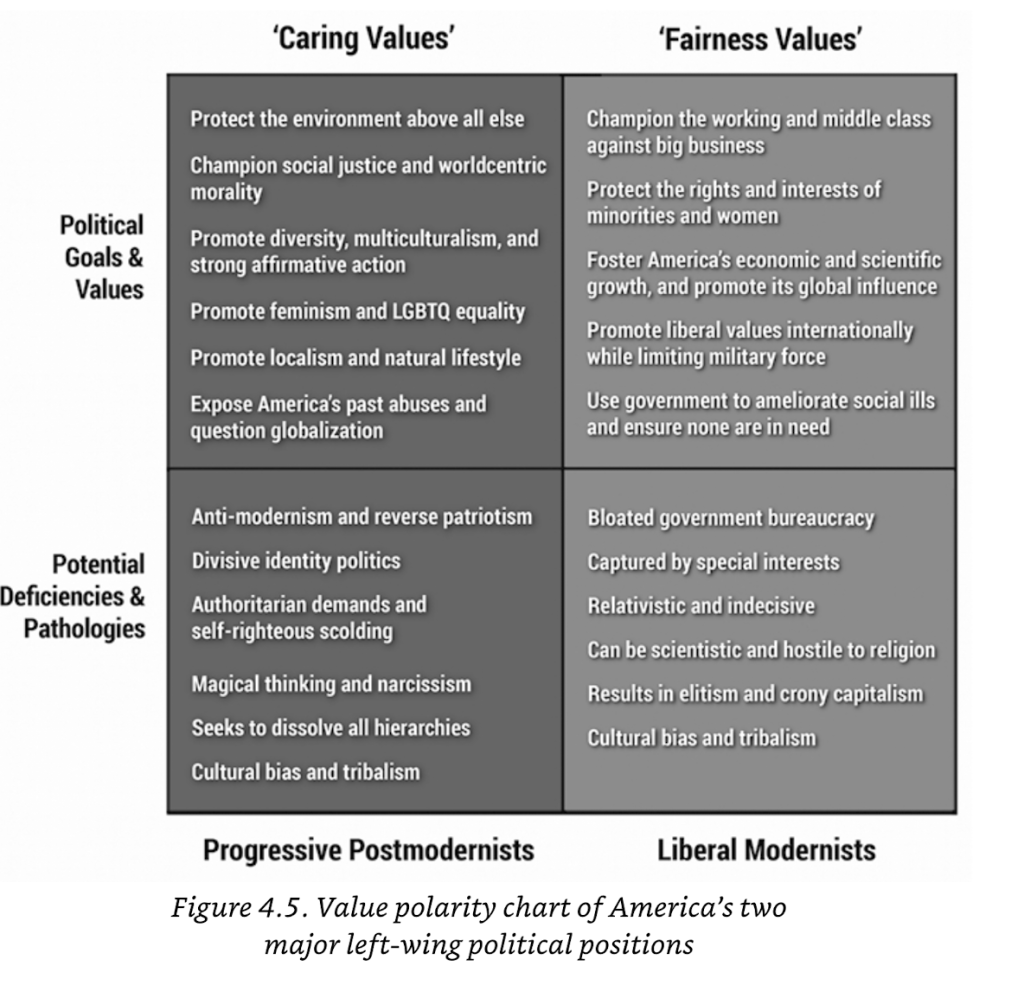
That implies we can’t just get rid of the worldviews that came earlier. We have to integrate them. Again, standard Ken Wilber stuff. I’m down.
The part where he kind of loses me is the proposal that we should embrace a bunch of virtues and then practice them together. There’s no real illustration of what that would look like. He goes to great lengths to show how the 7 virtues he chose aren’t arbitrary, but they still seemed quite arbitrary.
I actually don’t have anything against arbitrary, though. I would be supportive of anything that could bring our dysfunctional national family together in constructive dialogue and a shared conception of “we’re working on the same project”, even if I did have to swear to uphold the virtues of faith, love, and charity.
It just wasn’t clear to me, from the book, what that would look like. I’m thinking some version of the Peace Corps that’s Virtue Corps? Or maybe more ethical education in school (Gandhi would be into it).
In summary, I like the idea that we need some kind of spiritual abstraction that speaks to everyone, and that when we have such an abstraction, we will all feel interconnected and solidarity-ious.
I just have no idea what that layer of abstraction would be (yet).
Some quotes
Developmental psychologist Robert Kegan actually defines integral consciousness as “the capacity to see conflict as a signal of our overidentification with a single system.”
America’s major worldviews have emerged by pushing off against each other in history, so they cannot be simply included all together in one static position because that would sap the charge that gives them life. Rather, they must be integrated in a way that continues to preserve their respective challenge to each other.
Therefore, even as we seek to bring about greater political cooperation, we must not try to eliminate the existential challenges that are an essential element of the dialectical process of cultural evolution overall.
As I will argue in the pages ahead, gaining a fuller understanding of how notions of the transcendent influence our society is crucial for reestablishing the social solidarity needed for a functional democracy.
For most people, this concern for a greater good is grounded in an intuitive sense that there is a point to life beyond life alone. This sense of obligation to a greater good is thus usually connected to the notion that there is, in fact, something that is truly “higher” than the normal concerns of our everyday lives.
In order to generate the political will necessary to overcome our democracy’s dysfunction we need to rediscover the transcendent meaning of our civilization at a post-secular level of understanding. In other words, the remedy to our cultural dilemma can be found in an enlarged ideal of a transcendent higher purpose (or a coherent set of higher purposes) that can speak to the hearts and minds of modernists, postmodernists, and traditionalists alike.

