Future of Conflict #5: Getting Past No
This week I read Getting Past No by legendary negotiator and mediator William Ury. William Ury is a legend and I’ve been deeply influenced by some of his other books (Getting To Yes and The Third Side). This book, however, comes across as another “Business Book”, along similar lines as #3 Start With No (but with the opposite title).
I did pull out some themes, but nothing nearly as heavy as the Ken Cloke I’m going to drop in a couple of weeks. Boom!
Getting Past No is the sequel to Getting To Yes. Getting To Yes exposed the difference between positional bargaining (haggling for a rug) and interest-based negotiation, which explores the space where everyone can get their needs met. Getting Past No is a (somewhat) deeper look at how you can make this transition.
Remember, for the purpose of these business books, a negotiation is basically any human (or pet!) interaction. It could be what happens at bedtime to how you vote on the planning commission to where you go for spring break to who prints out the report on Monday.
He’s writing these books to address a central tension in conflict-avoidant people:
If we are “soft” in order to preserve the relationship, we end up giving up our position. If we are “hard” in order to win our position, we strain the relationship or perhaps lose it altogether.
Ury’s vision is that we transform the negotiation into a joint problem-solving game, where both parties are on the same side (whether they know it or not.)
That way, you get the best of both worlds:
Soft on the people, hard on the problem.
Okay, so how do you get the other person (“The Adversary” in Jim Camp’s language) to flip to a joint problem-solving approach?
I got five major techniques from the book.
- You always speak to them from their point of view.
- You focus on the process over the outcome.
- You control your reactions (ah, so easy!).
- Technical stuff around negotiating vs. alternatives (BATNAs)
- You build dispute resolution into the process.
You always speak to them from their point of view.
The first point echoes Jim Camp’s focus on getting into The Adversary’s mind. You use their language and see all trade-offs from their point of view.
The single most important skill in negotiation is the ability to put yourself in the other side’s shoes. If you are trying to change their thinking, you need to begin by understanding what their thinking is.
Naturally, this is done through a lot of good questions. Hopefully we all know that by now. But the point that’s hard to remember is that it doesn’t matter what the facts are, or how the facts look to you, but how the facts look to them.
Here’s some great advice from Ury’s Uncle Mel, who seems like a swell dude:
It has taken me twenty-five years to unlearn what I learned at Harvard Law School. Because what I learned at Harvard Law School is that all that counts in life are the facts – who’s right and who’s wrong. It’s taken me twenty-five years to learn that just as important as the facts, if not more important, are people’s perceptions of those facts. Unless you understand their perspective, you’re never going to be effective at making deals or settling disputes.
It doesn’t mean that they are right; it just means you need to understand how they see the world. I see this as critical to daily marital disputes as well as contentious national debates like gun control and immigration.
Our questions have to start with how They See The World before anything can be accomplished.
Once we do that, we can go back to examining their unmet interests, in their eyes. The primary blocker here is our own lack of creativity, which comes from our own judgment.
I keep saying this, so maybe it’s exactly what I need to hear right now. In Ury’s words, in order to find their true interests:
You have to jettison three common assumptions: that the other side is irrational and can’t be satisfied; that all they want is money; and that you can’t meet their needs without undermining yours.
This is all in the service of joint problem-solving, not being an angel (though there’s high overlap).
As long as there is a logical connection in their eyes between their interests and their actions, then we can influence them.
You don’t (and shouldn’t) adopt their point of view. But everything you “sell” has to make sense to their interests. Otherwise they are totally right in not wanting a deal.
You focus on the process over the outcome.
This is one of my favorite ideas in the book:
Negotiation is not just a technical problem-solving exercise, but a political process in which the different parties must participate in craft and agreement together. The process is just as important as the product. You may feel frustrated the negotiations to take as long as they do, but remember that negotiation is a ritual -– a ritual of participation. People see things differently when they become involved.
This echoes one of my key learnings in mediation: How good the solution is does not matter.
What matters is ownership. Each person has to feel ownership of the solution or it will not last (without enforcement). If you’re looking for voluntary agreement in a world where anyone can change their mind at any minute, everybody has to see themselves as an active and important participant.
This is also incredibly counter-intuitive if you come from an engineering or problem-solving background.
“Hey guys, I solved your parenting plan problem for you. It’s totally fair. Just sign it and move on.”
Nobody cares! Each person has two options:
- The way things have been going (no agreement)
- The solution on the table (Ury calls this The Golden Bridge)
Your power comes not from the costs you are able to impose, but from the contrast between the consequences of no agreement and the allure of The Golden Bridge. Your job is to keep sharpening the contrast until they realize that the best way to satisfy their interests is to cross the bridge.
My saying “it’s fair!” does not sharpen the contrast or make life easier for them. These things would, however:
- My presenting it in terms of their interests.
- My leading them to develop a solution themselves, through questions.
- My emphasizing the decision is theirs, without pressure or urgency.
There are some great stories about how Young Joe Biden and John F. Kennedy both did this in negotiations with the USSR.
You control your reactions (ah, so easy)
Every book I read this year will have a section on this. So I’ll just pull out my three favorite quotes and leave it at that.
On the strategic danger of reacting:
In reacting, we lose sight of our interests.
Advice from Thomas Jefferson:
When angry, count 10 before you speak; if very angry, 100.
Wouldn’t that be awkward to do? Hell yes. But still way better FOR YOUR INTERESTS than reacting from a place of anger.
Remind yourself:
Your challenge is to create a favorable climate in which you can negotiate.
Will your reacting help that? Probably not, dude.
Technical stuff around negotiating vs. alternatives
In Getting to Yes, Ury and Fisher popularized the concept of the BATNA: the Best Alternative to a Negotiated Agreement.
The BATNA is what you’re left with if things don’t work out. If you can’t agree on where to go to dinner, what will happen? If you can’t agree on passing the budget, what will happen? Each side has their own BATNA, which may be more or less satisfying to them.
With that in mind:
The purpose of negotiation is not always to reach agreement. The purpose of negotiation is to explore whether you can satisfy your interest better through an agreement then you could by pursuing your BATNA.
The goal is not agreement. The goal is satisfying your interests. Let’s say you’ve been dating someone for 2 months. The goal is not to get married. The goal is to be happy. Maybe that happens in this relationship. Maybe in another one. Maybe by being single. We do the dating to shed light on the options.
Here’s a simple graphic:

If you can’t get to the Purple Zone, there’s no point in coming to a deal. The point of the joint problem-solving is to show the other party when you’re not in the Purple Zone.
Once you’re in the Purple Zone, a lot of things can happen. One party can get more than the other, and Getting Past No doesn’t seem very helpful at that point (IMO).
One key aspect of Getting Past No is educating people about your BATNA. I don’t know what your BATNA is, and you don’t know mine. There might be some bluffing involved. But if I misjudge your BATNA, we are both more likely to lose:
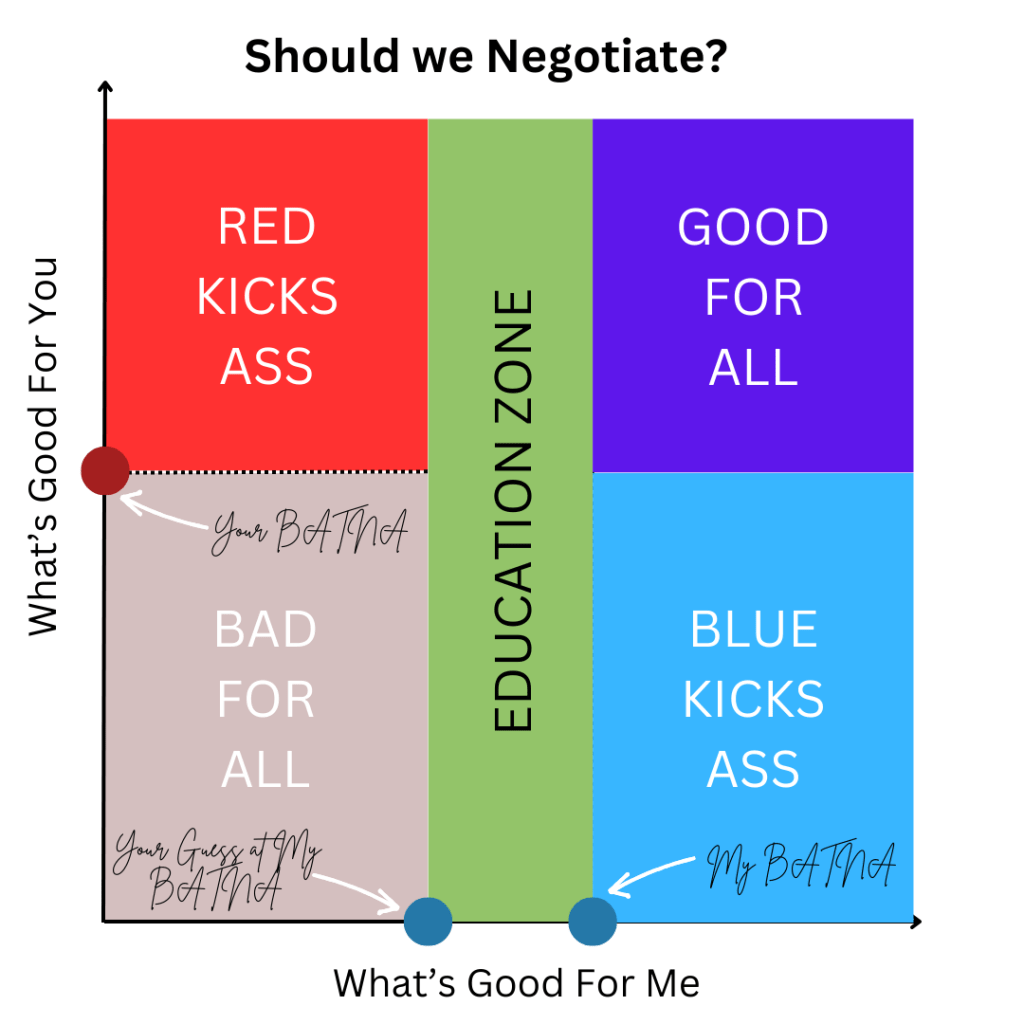
That Green Zone is no bueno because one person thinks it could be good and the other person knows it’s not. The presence of Green should lead to non-agreement, which is sub-optimal.
You build dispute resolution into the process.
This is obvious, short, and almost never practiced.
Your contract should spell out exactly what will happen if one party feels the other is not living up to the terms of the agreement.
I think this is a symptom of our conflict avoidance and mistaking “trust” for “protection”.
As the Arabic proverb goes:
Trust in Allah and tie up your camel.
After reading this, I started imagining every wedding ceremony naming and including the marital therapist. And every rental or business agreement between friends naming a list of trusted people who could help them mediate during a misunderstanding.
It would save so much trouble, legal action, and ruined relationships.
Even in the business realm, where this should be the default, it’s often lacking. I once mediated a disagreement between two start-up founders because their operating agreement included no provision for how one person could leave the organization fairly. Seriously.
Conclusion
Getting Past No is about:
Chang[ing] the game from positional bargaining to joint problem-solving.
That’s the One Thing to remember. And it has a nice spiritual ring to it. Every conflict is a team sport. A cooperative game. It’s not about what we think it’s about, so we have to go looking for that cooperative game. And when we find it, we have to educate the other party into seeing it too.
And that, according to Ury, is what winning looks like.
Together,
~ Ankur
 Ankur Shah Delight: Community and Conflict