
Last week I received an email from a college professor of mine, who has been an incredibly influential moral and intellectual presence in my life. He offered a deep criticism of the mediation approach, which will take me weeks or months to sit with and unpack.
I will use a few lines from his email to highlight the subtle difference between compromise and collaboration.
My professor wrote:
One issue I have with the conflict-resolution/mediation talk is simple. The right moves things to the right (way to the right in the current US) and then we try mediation so that we don’t see each other as enemies, but have respect for (fill in the blank: racism, sexism, greed, stupidity, lies, deception, manipulation) which must (I fear) move whatever resolution there might be to the right.
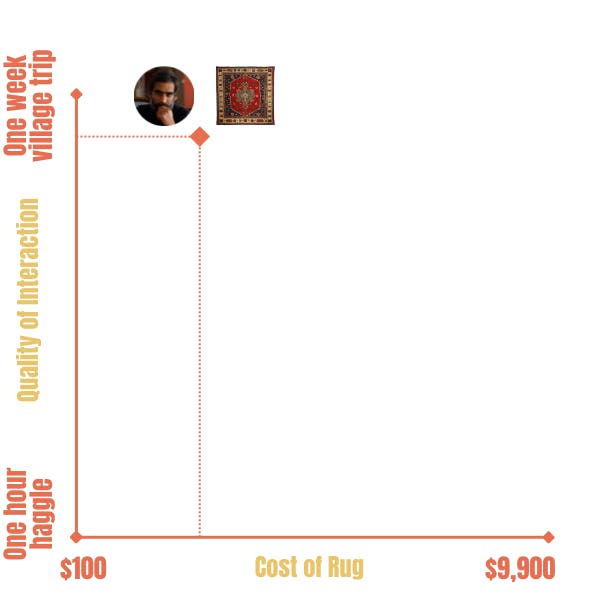
The standard definition of compromise is both sides moving their position closer to each other, and often ending up mutually unhappy. Think of haggling for a rug, “meeting in the middle”, and “splitting the difference”.

The downsides are obvious and the approach is vulnerable to one or both sides starting with an extreme position to shift the eventual midpoint.

That is, in fact, the logical approach if you know you will end up compromising. Rug sellers, politicians, and married people use this approach on the daily.
Collaboration, on the other hand, involves getting at the deeper interests of both parties and looking for a creative solution that includes both interests. This won’t be an “in the middle” solution, but rather a solution that adds another dimension to expand the decision space.
Here’s the subtle part that is Key to the collaboration process and the mediation mindset:
I feel a moral and practical obligation to respect a person, not their positions.
I don’t respect racism, sexism, invasions, and occupations. I don’t think there’s any spiritual or strategic value in respecting them.
I want to understand how these positions emerge and what deep needs they fulfill. I can only achieve that understanding by asking questions. I will only ask questions if I maintain my respect for the underlying humanity of the people who hold those views.
This is why Bernie does so well in town hall meetings with Trump voters. He understands the deeper interests and has solutions that meet those needs.
(It also helps that racism, xenophobia, and hateful rhetoric, though emotionally appealing, don’t solve the underlying issues.)
If conflict resolution starts with respecting everyone’s positions, my professor is right and we’ll move toward strategically placed extremes (“anchors” in negotiation lingo).
If conflict resolution starts with the assumption that the positions will guide us towards deeper interests that are inherently valuable, we have a shot at both:
- Not seeing each other as enemies
- Coming up with something that meets everyone’s needs.
This isn’t always possible and it requires a big assumption:
Behind every position and need, no matter how horrific, is something life-affirming.
Behind massacres and genocides and land-grabs and profiteering and demagoguery is a motivation I can whole-heartedly support and relate to.
This is a spiritual thing. It’s what Jesus and Gandhi and Marshall Rosenberg have in common. It can never be proven, but it is what allows an authentic conflict resolution process to get off the ground.
And, to get back to my professor’s argument, it’s what can save us from compromise.
 Ankur Shah Delight: Community and Conflict