
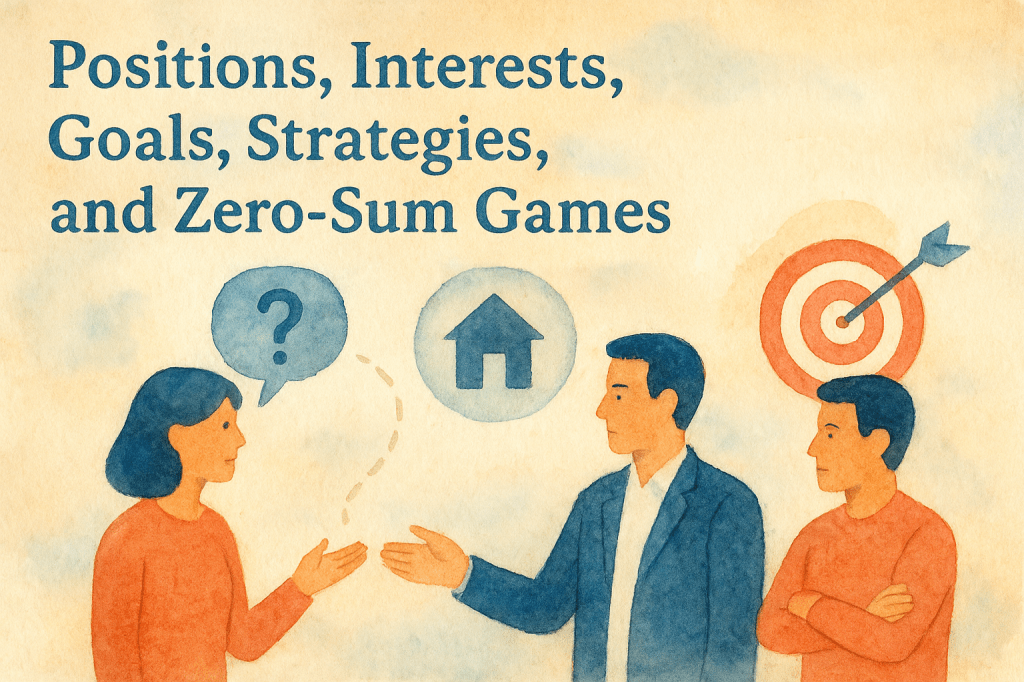
In mediation we often talk about positions vs. interests.
A position is an outcome you want, like
“I want the house.”
An interest is a deeper underlying reason why you want something, like
“I want to feel safe and comfortable where I live.”
Often, if someone comes in with a positions, I will encourage the other party to ask “Why?”, or ask it myself.
Party 1: “I want the house.”
Party 2: “He’s not getting the house!”
Ank: (to Party 2) “Do you know why he wants the house?”
Party 2: “Not specifically.”
Ank: (to Party 2) “Do you want to know?”
Party 2: “I guess so.”
Ank: (to Party 2) “Would you be willing to ask him?”
Party 2: (to Party 1) “Ok, so, why do you want the house?”
Party 1: “It’s the only place I’ve ever felt safe in my life.”
And then we have gone from a position to an interest.
The good thing about interests is they can be satisfied with a variety of options. Owning the house you lived in the for the last 20 years is a way to feel safe, but it is not the only way a human being has to feel safe.
Part of mediations involves all of us, as a team, exploring how we can all meet our interests.
I think about goals and strategies in a similar way.
A goal is what you want, while a strategy is how you get there.
Here’s a question:
“Can you draw up a QDRO to split up his 401(k)?”
A QDRO is a strategy to split up a retirement account.
Splitting up a retirement account is also a strategy.
But what is the goal?
Maybe the goal is a 50/50 split of assets. Maybe the goal is for both people to have an even tax burden or liquidity. We don’t know until we ask.
Mediation participants are experts in their relationship. They know all kinds of ways things have gone right and wrong in the past. They know what buttons to push to get the reactions they want out of the other party.
However, they are usually not experts in the technicalities around divorce. So they will often come in with strategies, and have some attachment to their strategies.
The strategies are usually unimportant. The goals are very important. The clearer we are about everybody’s goals, the easier it is to determine which strategy is the right one.
Another way to think about this is as zero-sum games. Zero-sum games are win/lose. If somebody wins, the other person loses. If I gain a point, it’s because you lost a point.
Tennis is a zero-sum game. Each serve ends with a point, either to you or to me (not both!).
You will not have a good experience in mediation if you treat it as a zero-sum game. That’s why we go from positions to interests. And that’s why we go from strategies to goals.
As a mediator, my goal is omni-partiality. I am on everybody’s side. I want to help each party act in a way so that their interests can be satisfied.
That can’t be done with positions.
If both parties “want the house”, I can’t be omni-partial. There’s only one house and they already decided they’re no longer sharing it!
But if I can find out what’s behind the position, for everyone, and everyone in the room understands what’s at stake for everyone else, we can (sometimes) satisfy everyone’s deeper interest, even with just one house.
 Ankur Shah Delight: Community and Conflict