
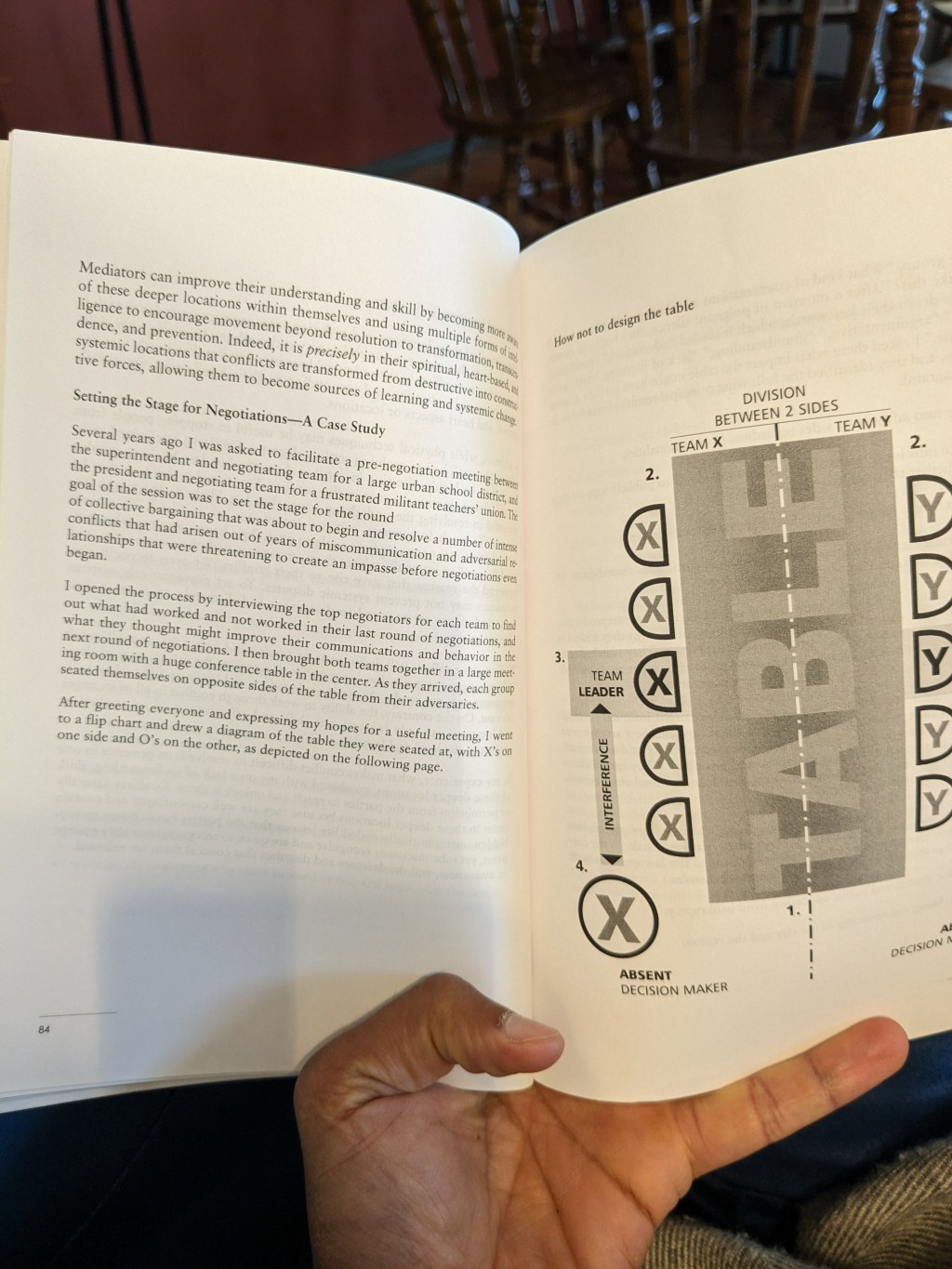
These notes are from a case study at the end of Chapter 3 of Ken Clokes’ Crossroads of Conflict.
It’s an AMAZING model/template of how to do things, and what’s possible when you slow down and ask the right questions.
In Ken’s example, the negotiation was between union representatives and a school district.
They had tried negotiations multiple times and failed.
Essentially, they were coming to together to argue about wages.
“Show me the money.”
Instead, this is what Ken did:
- Interview each person separately:
- What worked and didn’t work in the past
- Seating
- Sit down on opposing sides of the table
- Drew the table
- What kind of conversations are likely to take place at a table like this?
- What impact might this table have on their negotiations?
- Now, rearrange your seats in whatever you want to increase your chances of having a productive conversation
- Introductions
- Role
- Length of role
- What is at stake in the conversations they were about to have?
- Imagine all the stakeholders (children) were present during the negotiation. Would you be willing to consider those stakes when evaluating proposals today?
- Unaminously agreed
- Press: Agree on a set of ground rules for communication with the press
- Joint statements
- Leaders only
- No statements about progress
- Relational Goals
- Meet with your own side
- Select a facilitator and recorder
- Discuss your goals for your relationship with the other side
- Share with the group
- Perfect overlap
- Past Behaviors
- Meet with your own side
- What behaviors jeopardized or undermined the goals you just came up with
- Present to other side
- Other side has a chance to add/subtract/correct
- Honesty!
- List of behaviors they agreed to avoid
- Asked invididally for commitment (yes)
- Asked if others could remind them (yes)
- Moment of silence
- Reflect on what they had accomplished
- Share
- “Didn’t feel like collective bargaining”
- Priorities
- Meet with your own side
- Come up with priorities in order
- Low Priority Issues first
- Mixed teams for each issue
- Come up with multiple proposals for consideration
- Meditator records points of consensus
- Relatively quick to consensus
- Mid Priority Issues next
- Mixed teams for each issue
- Come up with multiple proposals for consideration
- Meditator records points of consensus
- Consensus, but it took longer
- Top Priority: Wages
- Expand the discussion to include decision-making, collaboration, and budgeting
- Each time come up with a number
- Also come up with non-monetary items
- Process worked because it was grounded in relationships
Notes on consensus:
p91
“Consensus is not the same as unanimity. Consensus requires willingness on the part of both sides to live with the group’s decision and to vigorously dissent if they prefer a different alternative. It means everyone affected by a problem should have a voice in its solution and participate in making decisions that affect their lives. If the group makes a wrong decision, it will try to learn from experience and do better next time, but the possibility that a group will decide incorrectly does not justify their exclusion from the responsibility of deciding.”
p91
“Even in the most adversarial, crisis-ridden negotiations, it is possible for passionately committed advocates to agree to avoid behaviors that undermine their relationship. Doing so encourages them to recognize that they are in the same boat, and ultimately it does not matter whose end of the boat is sinking.
By acknowledging and affirming what each side wants, needs, and has in common, they are drawn to think about their opponents’ needs, and improve their relationship as well.”
 Ankur Shah Delight: Community and Conflict